Case study

A website, and a booking system that finally got them off the phone.

Certified Pizza Catering roll in the ovens and cook fresh pizza on-site — birthdays, weddings, job sites, anywhere in Sydney they can set up. They had a website when we met them, but it wasn't pulling its weight. Every booking still came in as a DM or a missed call, and someone had to stop what they were doing to answer it.

Before · every booking came by DM
CP Certified Pizza 3 missed calls
Sat 11:41pm

Hey! Are you free the 14th? Backyard 60th, about 60 people

And how much roughly?

Hi! Let me check the calendar and get back to you 👍

Unanswered · 2 days later
After · the booking page we built
certifiedpizzacatering.com.au/book
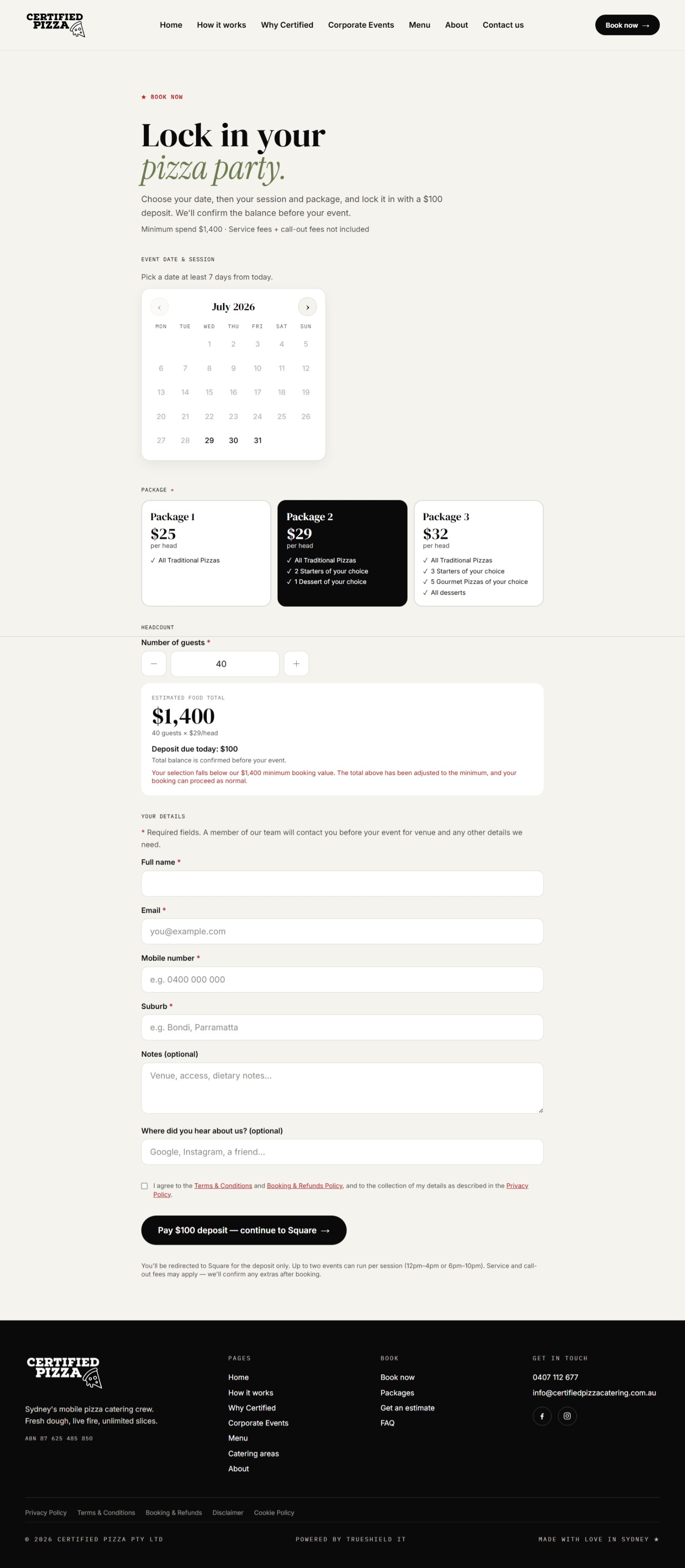
The full booking page we built for Certified Pizza: pick a date at least seven days out, choose one of three packages ($25/$29/$32 a head), set the headcount to see the live total against the $1,400 minimum, and pay a $100 Square deposit.

No more back-and-forth. They book, pick a package and pay the $100 deposit in one go.

A booking used to take four messages and two days

There was never a shortage of enquiries. The trouble was answering them. Every one needed a person, and the only people who could answer were usually flat out cooking.

Someone would ask about a Saturday. To find out, you'd have to go and ask the one person who kept the calendar in their head. Then they'd want a price, so you'd talk them through the packages again. Then the headcount, which never stayed the same for long. A few days later the date had either gone to someone else or the customer had gone quiet, and no one could tell you which.

None of this is unusual for a catering business, and none of it ever shows up as a lost booking you can point to. It shows up as evenings eaten up by the phone, and the enquiry that came in at 11pm and sat there until Monday, long after the customer had moved on.

Here's how a booking goes now.

The site went up first, covering the things people used to ring up and ask: what they cook, how it works, what it costs. The booking system is the bigger piece. It goes from the date to the deposit, and none of it needs someone at Certified Pizza to be free to answer.

  1. Pick the date

    The calendar won't offer a date sooner than seven days out. That's how long the kitchen needs to shop and prep, so nothing gets booked that can't be cooked properly.

  2. See what's free

    There are two sessions a day, 12pm to 4pm and 6pm to 10pm, and each one can take two events. The page checks what's left before it offers you anything, so the same slot can't go out twice.

  3. Choose a package

    Three packages, from $25 to $32 a head, with all the details written out under each one.

  4. Set the headcount

    Put in a number and the estimated food total moves with it. If it lands under the $1,400 minimum, the page says so before you go any further.

  5. Pay the deposit

    $100 through Square holds the date, and the balance is settled with a person before the event.

  6. Or just ask

    Not everyone wants to book on the spot. The enquiry form takes the date, location, headcount and package, so whoever replies within 24 hours isn't starting from scratch.

Why the page only takes $100.

Charging the full amount up front would have been the same build, so this wasn't a technical decision. We didn't do it because a pizza catering job isn't a checkout. The headcount changes, people add things on, and someone still has to work out where the van can park. If a customer pays in full before speaking to anyone, they haven't really booked anything yet.

So the deposit is only there to hold the date. The session comes off the calendar, nobody's keeping a Saturday free for a maybe, and then someone from the business picks it up and confirms the balance before the event.

The automation was the straightforward part. The real decision was where to make it stop.

The page
  • Locks the date and the session
  • Takes $100 through Square
A person
  • Calls to settle the rest
  • Confirms the balance before the event

Two people get their evening back.

There's no dashboard metric to point at here. What changed is a list of things nobody has to do anymore, on both sides of the booking.

For the person booking

  • Books at 11pm and has the date held by 11:02, without waiting on a reply
  • Sees the price for their own headcount before they have to ask a human for it
  • Leaves with a confirmation and a receipt, instead of a "let me check and get back to you"

For Certified Pizza

  • Once a session is taken it comes off the calendar, so the same slot can't be booked twice
  • Packages and the minimum spend are stated once, on the page, instead of renegotiated per message
  • A deposit means a booking is committed before it takes up a Saturday
  • The phone can go back to being a phone

The website was the visible half.

A booking system is more than a website. It has to keep track of a calendar and take money, and it has to get both right at nine on a Saturday night when there's nobody around to fix it.

So we don't hand the website to one company and the software to another, with someone else again on the domain, the email and the server it runs on. It all works together, so the same people look after all of it.

Website design

Custom software

What would yours take off the phone?

Tell us where the manual work is — the bookings, the forms, the thing someone retypes every week.

Book assessment